
Arts Remembrance: Fanny Howe — A Poet for the Spiritually Audacious
By John Mulrooney
Fanny Howe’s writing pursued, as she put it, “bewilderment as a poetics and a politics.”
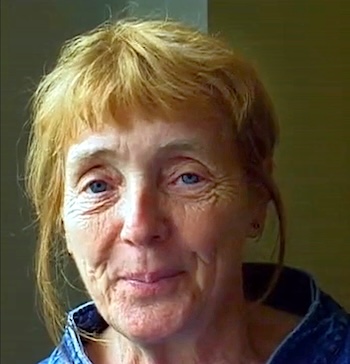
The late Fanny Howe in 2003. Photo: Wikimedia
Poet, novelist, essayist and activist Fanny Howe died on July 8 in hospice care. She was 84. The author of more than 34 books, she lived in Cambridge most of her life. Among her writings are the essay collections The Needle’s Eye: Passing Through Youth (Graywolf Press) and The Wedding Dress: Meditations on Word and Life (University of California); 15 volumes of fiction, including Radical Love: Five Novels (Nightboat Books); and 16 volumes of poetry, including Gone, Love and I, and the National Book Award finalist Second Childhood (Graywolf Press). She also made several films.
Fanny was born during the 1940 lunar eclipse in Buffalo, New York. The family soon returned to Cambridge where her father, Mark DeWolfe Howe, after serving in World War II, accepted a position as a law professor at Harvard University. A scion of an old Boston Brahmin family, he was a clerk for and biographer of Supreme Court Justice Oliver Wendell Holmes. Her mother, Mary Manning was an Irish actress and playwright who worked in Dublin’s Abbey Theater with such figures as Samuel Beckett, and was one of the founders of the Poets’ Theater in Cambridge in 1960. Howe was the middle child, three years younger than her sister Susan, herself also a noted poet and critic. Her younger sister is the painter Helen Howe Braider.
Howe had two marriages. The first in California, to Frederick Delafield, lasted two years and ended in divorce in 1963. In 1967, she met and married editor and activist Carl Senna, with whom she had three children, Lucien, Maceo and the novelist Danzy Senna. After her return from California, she met many of the Boston writers with whom she would deepen connections over the years, including Bill Corbett. Her life with Senna helped solidify her role as an activist, one already nurtured by her father, and one that remained intertwined with her writing for the rest of her life. After she and Senna divorced, she faced the struggle of raising three biracial children in Boston during one of its most tumultuous racial periods.
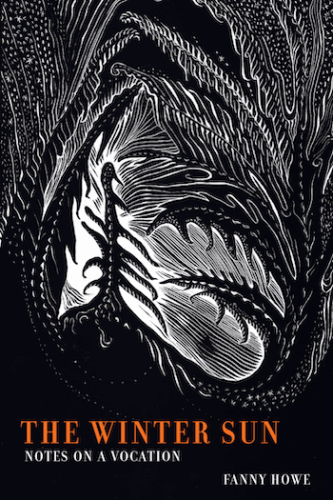 Her writing is notable for its hybridity. Her work pursues, as she put it, “bewilderment as a poetics and a politics.” Her novels are energized by a granular lyricism more often encountered in poetry. Her poems often explore material most writers would consider the terrain of the essay. A Google search for her 2016 book The Needle’s Eye (Graywolf Press) reveals reviewers and booksellers who are quite divided about whether to characterize the book as poetry or essay. 2021’s Manimal Woe (Arrowsmith Press) is similarly genre bending — a series of responses to letters her father sent her when she first left home. In that book she quotes her father from one of these letters — “Liberty and equality are incompatible. That is the first contradiction you need to know. It describes the fault line in America and in its Constitution.” In an interview/conversation with Askold Melnychuk and Thomas Sayers Ellis marking the publication of Manimal Woe, Howe speaks of her mother — “My mother brought all the language of Ireland with her, and that was what threw me off, I would never have done anything without the sound of my mother’s language.”
Her 1982 conversion to Catholicism affirmed a spirituality that, while a central occupation of her poetics, might to some readers seem unmoored, leaning more to the gnostic than the doctrinal. In a recent interview with the Paris Review, Chloe Garcia Roberts asked Howe about faith, and she responded that her subject was doubt — “I would think of poetry as a place where you connect your doubts to the things you don’t doubt. Free-floating doubt wouldn’t trigger the lightning that contradiction does. Because paradox really is deep. I’ve always been fascinated by the way (Simone) Weil held that balanced position between her love of Catholicism and her utter rejection of the church. I feel her dilemma with her.” The poet Patrick Pritchett explores this further in his excellent book Make It Broken: “She positions herself resolutely as a defiant outsider within the Church, which makes her a poet for the more spiritually audacious,” he writes.
Howe spent more than a decade in California teaching at the University of California San Diego, from which she retired in 2000. She also taught at Georgetown, MIT, Tufts, and the University of Massachusetts Boston.
For many years, Howe remained dedicated to the small presses that originally responded to her often experimental work. As poet Bill Corbett said during a 2002 interview, “The bright books she has written are not diminished by the relative obscurity within which she and other significant American writers labor. Few have worked in as many ways — both in terms of form and venue — as Fanny Howe.” Her work has since then been the focus of a gradual and steady expansion in attention, leading to profiles and reviews in mainstream outlets such as The New Yorker and The New York Times. Her awards include the Ruth Lilly Poetry Prize, the Lenore Marshall Poetry Prize, and the Gold Medal for Poetry from the Commonwealth Club of California.
“I dropped the book, wept, and went to the movies.” So begins the final section of Fanny’s long poem “A Hymn” from 2011’s Come and See (Graywolf Press). Her film work includes collaborations with Sheila Gallagher, John Gianvito, and her son Maceo Senna, and reveals much about her poetics. When introducing a screening of her films at Harvard, poet and scholar Keith Jones noted that her films act “as further evidence of how fully her genius lies in making genres overlap and misbehave. If we imagine genre as a territory, she is the trespass figure at its margins.” Fanny was a fixture at the Brattle theater and the Harvard Film Archive and many other theaters around town.
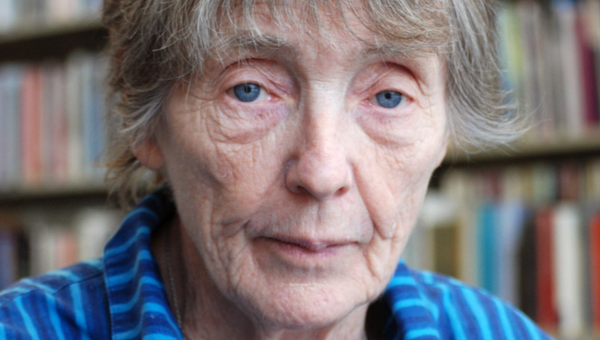
Fanny Howe — For many young poets visiting Boston, a visit with Fanny was a sought after audience and she often obliged. Photo: Tribeca
Fanny once wrote that the Boston of her childhood had the feel of a graveyard. And she always maintained an ambivalence about her hometown (a cornerstone of this writer’s relationship with her). That ambivalence aside, scores of younger artists, locally and nationally, can attest to the degree to which she enlivened the city. She was present in greater Boston — going to readings and events in the halls of august academic institutions and at more ecumenical venues such as the Boston Poetry Marathon and the Gloucester Writers Center. For many young poets visiting Boston, a visit with Fanny was sought after, and she often obliged. Her generosity to younger poets leaves a gap in the literary life of Boston and beyond. It also offers a challenge to younger writers in the model it provides.
At the time of her death, she had just completed another book. Tentatively titled “This Poor Book: New and Selected Poems,” it is expected out soon from Graywolf Press.
John Mulrooney is a poet, filmmaker and musician living in Somerville, MA. He is the author of Spooky Action from Dos Madres Press and a chapbook, If You See Something, Say Something, from the Anchorite Press, and co-producer of the award-winning documentary The Peacemaker, from Central Square Films. He serves as poetry editor for The Arts Fuse and Boog City. He is Professor of English at Bridgewater State University.
Tagged: "Second Childhood", "The Needle’s Eye: Passing Through Youth", "The Winter Sun: Notes on a Vocation"
Very nice tribute, John.