
Poetry Commentary: Antigone Kefala — Voice from Another Shore
By James Provencher
Like her sisters in the art of crystalline complexity, Australian poet and novelist Antigone Kefala persevered through years of isolation, obscurity, and critical neglect.
Commemorative Edition: Fiction/Poetry by Antigone Kefala. Two Volumes: Fiction (375 pages), Poetry (287 pages). Paperback/Boxed Set: $80 (AUD), available singly for $34.95 (AUD), Giramondo Publishing.
 The long-neglected and often marginalized Australian poet and novelist Antigone Kefala died in 2022 in Sydney at the age of 91. Thankfully, her publisher, Giramondo, has recently gathered a life’s work of seventy years into a Boxed Commemorative Set Edition.
It is a gift to have her complete works available in two immaculate, compact volumes: two hundred poems, six novellas, and ten short stories. A somewhat slim oeuvre, some would say, but Kefala’s formidably distilled vision resonates with considerable lyric power. Her prose and the poetry are spare, elliptical, and minimalist. Highly compressed force-fields, Kefala’s creations are primed to detonate, to release what she believed to be deeper nurturing forces and energies. Reading her work, one is put in mind of Sappho, Emily Dickinson, Anna Akhmatova, and Elizabeth Bishop. Like her sisters in the art of crystalline complexity, Kefala persevered through years of isolation, obscurity, and critical neglect.
A newcomer from an old country, a High Modernist European type who was out of step with Australia’s vogue in the ’50s for social realism, Kefala was early on labelled an ‘outsider’ because of her gender and ethnicity, excluded because she was pursuing an immigrant aesthetic. Summing up the early years, Kefala recalled: “I always felt that I was trespassing, that I was left waiting by the wayside, passed by, shunted to the side of the road.”
Recognition would come, but late. In 2005 she finally won Australia’s most esteemed poetry prize, The Judith Wright Calanthe Award. Then, shortly before her death, she won the country’s highest literary honor for her body of work: The Patrick White Award. That must have been ironically gratifying for a monastically modest artist who wryly maintained: “Reputation is something one must avoid at all costs.”
Kefala’s backstory is an archetypal journey to find a new home in a new world. Born in 1931 in Brailia, Romania to a Greek family that originally hailed from near Ithaka, she grew up speaking French at school and Romanian at home. Her father spoke Greek. The Germans invaded at the beginning of World War II. Then, with their retreat, the Russians marched in, forcing the family to live for three years in Greece, first in an abandoned orphanage, then in a displaced persons camp. Waiting for transit to somewhere, anywhere, Kefala learned Greek, her third language. She called this her refugees-in-waiting period: “Foreign here, there, foreign everywhere.” It was 1950 and she was sixteen when she finally traveled to another dislocation, another hemisphere, down under in New Zealand.
The Promised Land
The roads were of candy
the houses of ice cream
the cattle of liquorice.
Pretty, we said,
drinking the green air,
as in a fairy tale we said,
eating the green water, brackish,
breathing the smoke that rose
from the greenstone hills
and the moon alone
nailed to the bottom of the sky.
In the ’50s, when Kefala, as part of the post-war Greek Diaspora, reached New Zealand and then Australia, she found both countries firmly in the cultural grip of Western empire, colonialism’s long hangover: “I found these places to be more English than English, a people merely shifting from a small to a larger island.” “The Dominant Culture,” she observed, “complains there are too many voices while the minority one complains there are too few.”
 Working for the Maori Cultural Council in New Zealand, and then for the National Arts Council in Australia, Kefala fought for a number of causes. They included broadening official definitions and categories of aesthetic-creative pursuits by immigrant artists, as well as challenging patronizing expectations of ethnic writing. She had arrived at a propitious time; Australia was beginning to undergo a questioning of its national identity — there were intimations of a great sea-change.
Responding to socio-political pressures as well as political realities, the government embraced diversity as a national program, welcoming a wide range of refugees, encouraging European and Asian-Pacific immigration. The influence exerted by this foreign influx was deep and dramatic: it expanded the confines of the country’s Anglophile arts culture. Australia’s cultural coming of age paralleled Kefala’s own rite of passage as a young female writer trying to find a place to belong.
Understandably, Kefala’s early work — the novellas and short stories — fits into the Bildungsroman genre. In her case, Kefala traces migrant female characters who are navigating the travails of growing up challenged by cultural dislocation, linguistic estrangement, and aesthetic and gendered restrictions. The titles of her early fiction are telling: The First Journey, The Boarding House, The Island (a tri-lingual edition in Romanian/French/Greek), Alexia (Kefala’s child-persona), Intimacy, and Waiting.
Strangers in a strange land, Kefala’s fictional personae are forced to negotiate a life as they decipher alien mores, maneuvering their way across the minefields of English. This was the writer’s fourth acquired tongue, and she pronounced it to be a rather pragmatic instrument. These fictional transits into female adulthood are unsettling, at times wrenching, but always enlightening. Kefala’s vulnerable, questing protagonists learn to tread carefully — a misstep can lead to alienation, loneliness, and emptiness. Scenes of serene stability for these characters prove to be false; a sharp tear, a rent, arrives and suddenly the bottom falls out. These are tales of tenuous footholds in a fragile world; their detached, understated tone casts a spell of twilit expectancy.
The heroine of Alexia, for instance, is a young girl caught between two cultures. She arrives in New Zealand with a small suitcase of memory, a few books, and a violin. Kefala called New Zealand, her first home, a place where “the Elders had read the signs and buried the magic.” These Elders, of course, were the Maori, and it was this very ‘magic’ she sought to absorb and display in her fiction and poetry.
Departing New Zealand for Australia in 1959, Kefala sailed through Sydney Harbor, where she was first struck by the light: “numinous, Grecian-bright, a palpable honey-apricot, milky and powdery. The platinum bay aglitter, sandstone cliffs at the Gap, glowing amber.” She felt buoyed, almost at peace. Sydney would be her residence for the next 70 years. Settled in a home at the edge of the harbor, she primarily wrote poetry. These are the books for which she is the most admired: The Alien, Thirsty Weather. European Notebook, Absence, Journeys, and Fragments.
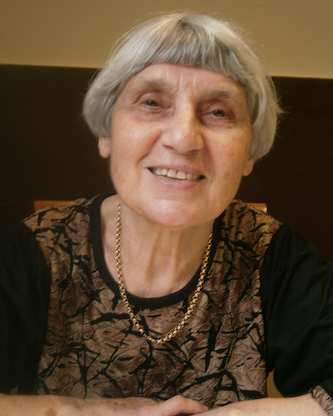
Poet Antigone Kefala. Photo: Antigone Kefala Memorial Prize
She had undergone considerable difficulties, but now, on a farther shore, where the First Peoples sang to keep everything alive, her feet were planted on hard but fertile ground. In her verse she embarked on mapping journeys into her interior zones. She called these explorations of consciousness “serious business”: “Everyone forgets that writing arises out of an inner necessity, that each piece has its own measure, determined by itself, which no one can alter without altering its nature.” In other words, one had to bring a tenacious sense of organic form to the task of probing inner landscapes. In his poem “The Next Life,” William Carlos Williams articulated the point compactly: “The sea is not our home—Inland we must go.”
Out on the very edges of South Australia, in a terrain so rough and hostile that the early explorers gave up and turned back, the last small rise was named Mt Hopeless. That is where Kefala’s poems begin, and press further on: tracing primal journeys, leaping from outer to inner landscapes, from the known into the unknown, from the earth into the metaphysical, from charting the space in dreamtime to speculating about existence in the afterlife.
As a child, while searching for shells on the beach with her mother, Kefala listened carefully to the susurrus of the sea within herself. And that inspired questions: “Do you hear the sea inside me? Does your heart open to my voice?” These interrogatives are at the center of Kefala’s elemental questing vision — humanity’s search for a home.
Coming Home
What if
getting out of the bus
in these abandoned suburbs
pale under the street lights,
what if, as we stepped down
we forgot who we are
became lost in this absence
emptied of memory
we, the only witness of ourselves
before whom shall the drama be enacted?
James Provencher, a U.S. expat living in Canberra, Australia, is a former teacher/poet in residence at The Frost Place, Robert Frost’s farm and museum in Franconia, NH.
I remember a time (1980s and early 90s) when finding English translations of contemporary writers in Eastern Europe and South America was a challenge. Eventually,through efforts by Philip Roth and others, this changed.I still have Penguin editions of work by writers like Kundera, Jerzy Andrzewjewski, Bohumil Hrabal, Tadeusz Borowski, Isabel Allende, Jose Varas, and others. Reading James Provencher’s insightful piece on Australian poet and fictionist Antigone Kefala, I got a feeling of discovery. Hers is a name I’ve heard but whose work I have not read. Now the opportunity awaits. Thanks for this review.